SME Cash Flow Improvement System
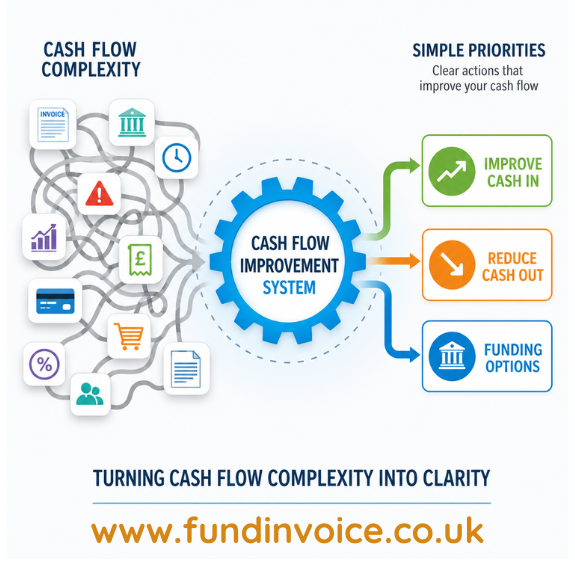
Business cash flow problems are not always caused by a lack of funding. In many cases, cash flow pressure can result from slow customer payments, weak sales performance, high costs, low profit margins or a combination of factors.
This free SME Cash Flow Improvement System helps identify potential pressure points in your business and highlights practical options to improve your position. The tool considers sales, marketing, credit control, profitability, costs and funding to provide a broad indication of areas that may warrant further attention.
Unlike many cash flow calculators that focus solely on borrowing, this tool explores a wider range of possible solutions, including improving cash collection, increasing sales, reducing costs and strengthening working capital.
Simply enter your figures below to receive an instant assessment.
SME Cash Flow Improvement System
Figures are indicative only. This tool gives a broad cash flow indication and is not financial advice.
Understanding The Results
The system provides a general indication of your current cash flow position based on the information you enter. It estimates overall cash flow health and attempts to identify the area placing the greatest pressure on cash flow.
For example, some businesses suffer from slow-paying customers despite being profitable, whilst others may be generating insufficient sales or operating with costs that are too high relative to turnover.
The recommendations generated are designed to provide ideas for further investigation rather than definitive solutions. Every business is different, and professional advice may be required before implementing significant changes.
Additional Cash Flow Resources
If the tool identifies areas of concern, the following resources may also be useful:
- Guide to Credit Control
- Invoice Finance
- Invoice Finance Costs Information
- Business cash flow guidance
- Cash Flow Health Check And Fix Kit
Common Causes Of Cash Flow Problems
Cash flow pressure can arise for many reasons, including late payment, excessive debtor days, declining sales, poor profit margins, rapid growth, seasonal trading patterns, unexpected expenditure or insufficient working capital. Identifying the underlying cause is often the first step towards finding an effective solution.
Creating A Cashflow Improvement Plan
Many businesses use the results from this tool as a starting point when creating a cash flow improvement plan. Once the primary causes of cash flow pressure have been identified, a structured plan can be developed to improve sales, collections, profitability, costs or funding.
For further guidance, see our article on how to write a cash flow improvement plan.
FAQs
What is a cash flow improvement system?
A cash flow improvement system is designed to identify potential causes of cash flow pressure within a business and suggest actions to improve the position. Potential solutions may include improving sales, reducing debtor days, lowering costs or introducing additional working capital.
Can this system predict future cash flow problems?
The system provides a broad indication based on the figures entered. It does not replace a detailed cash flow forecast and should not be relied upon as a prediction of future performance.
Does poor cash flow always mean a business is unprofitable?
No. Many profitable businesses experience cash flow pressure because customers take a long time to pay invoices or because growth requires additional working capital.
What are debtor days?
Debtor days measure the average amount of time customers take to pay invoices. Higher debtor days generally mean cash remains tied up in unpaid invoices for longer.
How can businesses improve cash flow without borrowing?
Possible options include improving credit control procedures, collecting debts more quickly, reducing unnecessary expenditure, increasing sales, improving profit margins and negotiating better payment terms with customers or suppliers.
When should a business consider funding?
Funding may be worth considering when otherwise healthy businesses experience cash flow pressure due to growth, slow customer payments, seasonal trading patterns or one-off events.
What funding options can help improve cash flow?
Depending on the circumstances, businesses may consider invoice finance, selective invoice finance, trade finance, revolving credit facilities, business loans, asset finance, or other working capital solutions.
Is this cash flow improvement system free to use?
Yes. The system is provided free of charge and can be used as often as required.