- 13 Aug
Loan Stacking And Alternatives To Business Loans
Taking out a business loan can be an effective way to finance a one-off requirement. However, what happens when a business takes one loan, then another, and perhaps another after that?
This is sometimes described by finance providers as "loan stacking". It can happen when a business has an ongoing need for working capital but repeatedly addresses that requirement by taking additional fixed-term borrowing.
There is nothing inherently wrong with having more than one finance facility. The important question is whether repeatedly adding loans addresses the underlying funding requirement or simply provides a succession of temporary cash injections. The other effect of using loans for this kind of borrowing is that as repayments increase, the amount of funding reduces as the capital sum has to be repaid.
What Is Loan Stacking?
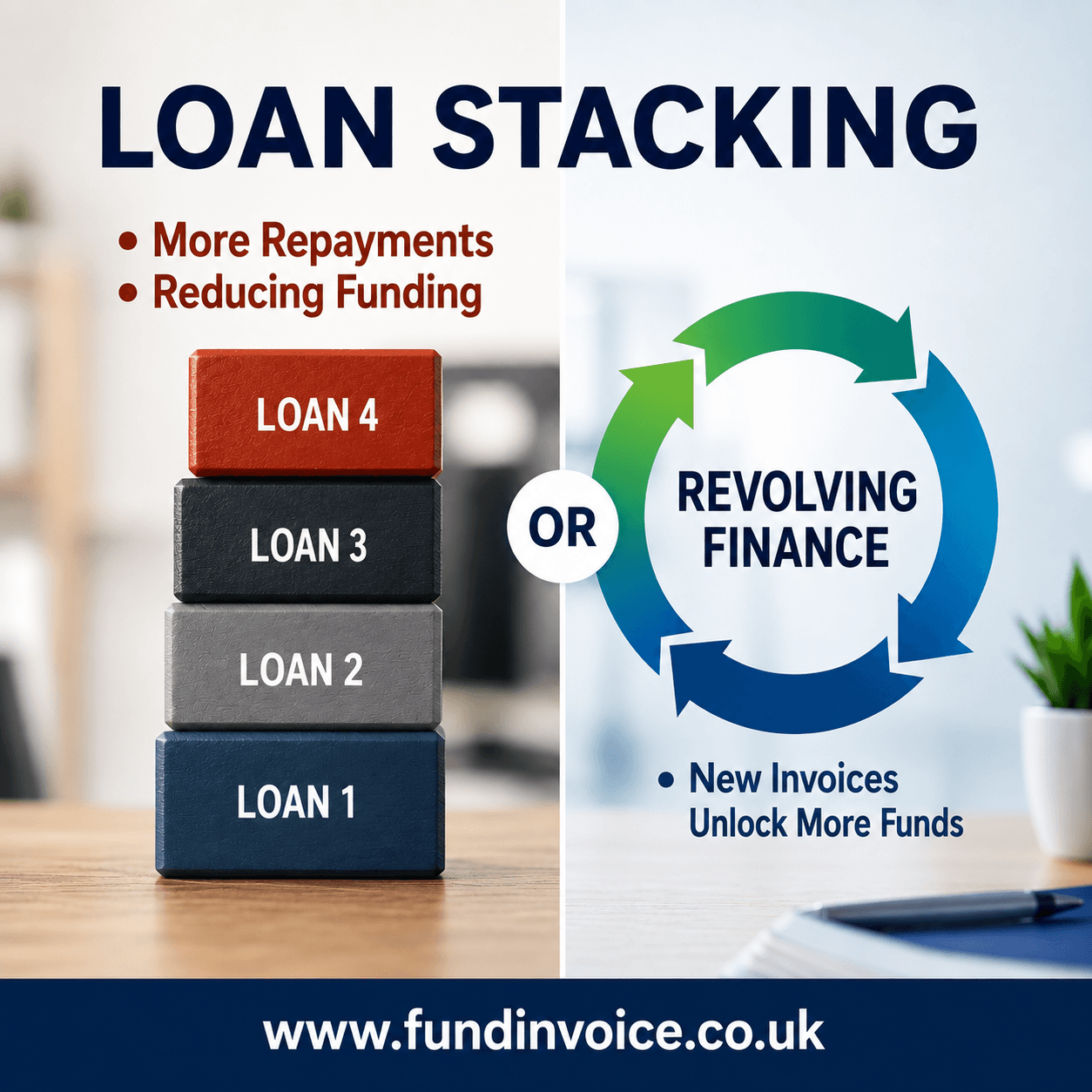 Loan stacking generally refers to a situation in which a business has multiple loans or similar borrowing facilities in place at the same time, often arranged one after another.
For example, a company might take a loan to provide additional working capital. As the original capital is gradually repaid, the business may find it still needs cash and therefore arrange another loan. This can result in several repayment commitments running concurrently.
That doesn't automatically make loan stacking inappropriate. Businesses can have perfectly valid reasons for using several different sources of funding. However, repeated borrowing can sometimes indicate that the business has a recurring working capital requirement rather than a series of one-off funding needs.
A real example of multiple business borrowing: We recently examined Companies House filings for a company entering a proposed liquidation process. Its creditor information included numerous recognisable business finance providers, raising questions about the cumulative impact of multiple credit facilities. Read our article When Multiple Business Loans Become A Problem.
Why Businesses Can End Up Stacking Loans
A conventional term loan normally provides a fixed amount of money at the outset. The borrower then gradually repays that capital, together with the agreed interest and charges, over the term of the loan.
This structure can make good sense when the finance is being used for something with a defined cost, such as:
- buying equipment or machinery;
- refurbishing premises;
- purchasing stock for a particular requirement;
- funding an acquisition;
- meeting another identifiable one-off cost.
The situation can be different where the underlying requirement continually returns.
For example, a business may be profitable but regularly have substantial amounts of money tied up in unpaid invoices. A loan can inject cash into the business, but as the loan is repaid, the underlying delay between making a sale and receiving payment from the customer remains.
If another loan is then needed to replace that cash, it may be worth considering whether a different type of finance would better match the underlying requirement.
When Might An Alternative To Another Business Loan Be Appropriate?
The key distinction is often between a one-off funding requirement and a repeating funding requirement.
If you need a fixed amount for a particular purpose, a loan may be an appropriate option. We regularly help businesses find both secured and unsecured business loans.
However, if the requirement for additional working capital keeps recurring, it can be useful to consider financing that can be drawn or repaid as the business needs change.
There are several possible alternatives depending upon the circumstances.
Replacing An Existing Loan With A Larger Loan
Taking an additional loan alongside existing borrowing is not the only option. It may sometimes be possible to refinance the existing loan with a larger new facility, using part of the new borrowing to repay the original loan and providing the business with additional funds.
This can avoid having several separate loans running at the same time. Whether it is appropriate will depend on the terms, costs and circumstances of the business. See our guide to extending or increasing a business loan for more information.
Revolving Business Finance
A revolving facility allows money to be drawn, repaid, and potentially drawn again under the facility's agreed terms. This differs from a conventional term loan, in which the original capital balance typically decreases as repayments are made.
For some businesses, a revolving business loan may therefore be worth considering.
Invoice Finance
If the recurring requirement stems from customers taking time to pay invoices, invoice finance may be an alternative.
Instead of providing a single fixed lump sum that is gradually repaid, invoice finance releases funding against outstanding customer invoices. As customers settle invoices, the associated funding is cleared, while newly raised invoices can generate additional availability.
This means that the funding can continually revolve with the sales ledger rather than simply reducing as a fixed loan is repaid.
This structural difference is why invoice finance can sometimes be more suitable for a business with a permanent or recurring working capital requirement.
A business may be able to use invoice finance alongside an existing business loan.
Selective Invoice Finance
A business may not need to finance its entire sales ledger. Selective invoice finance can allow individual invoices or selected customers to be funded, depending upon the facility.
This can be useful where the working capital requirement is occasional rather than continuous.
Asset Finance
If the money is specifically required to purchase machinery, vehicles, or equipment, secured finance against the asset itself may sometimes be more appropriate than using a general-purpose loan for the entire requirement.
The right structure depends on the asset, the business, and the finance required.
Loan Stacking Versus Revolving Finance
The difference can be illustrated quite simply.
Funding situation Possible approach One-off identifiable expense A term business loan may be appropriate Funding that needs to be drawn and repaid repeatedly A revolving finance facility may be worth considering Cash continually tied up in unpaid B2B invoices Invoice finance may address the underlying working capital cycle Occasional large invoices causing cash flow pressure Selective invoice finance may be an option Purchase of specific equipment or machinery Asset finance may be appropriate These are not hard-and-fast rules. Businesses often use more than one type of finance, and the right solution depends upon the circumstances.
Does Having Several Business Loans Mean You Have A Problem?
No. Having several loans does not by itself mean that a business is over-borrowed or using the wrong type of finance.
A growing company might legitimately have different facilities covering different requirements. It could, for example, have borrowing associated with an acquisition, equipment finance and a working capital facility at the same time.
The more useful question is why another loan is required.
If each facility is financing a separate, defined requirement, multiple facilities may make perfect sense. If additional borrowing is repeatedly needed simply to restore working capital as previous loans are repaid, there may be value in examining the underlying cash flow cycle.
Invoice Finance As An Alternative To Repeated Borrowing
For businesses selling to other businesses on credit terms, one of the largest assets on the balance sheet can be the money owed by customers.
Invoice finance can release some of that money before customers actually pay. Importantly, new invoices can generate new funding, so the facility can potentially increase as sales and the debtor book grow.
This contrasts with a conventional term loan, in which the original amount borrowed typically decreases over the repayment period.
We explain these structural differences further in our comparison of business loans versus invoice finance.
Sometimes Another Business Loan Is Still The Right Answer
It is important not to assume that revolving finance is automatically better than borrowing.
A loan can be simple, predictable, and well-suited to a fixed funding requirement. A business may also have circumstances where invoice finance is unavailable or simply doesn't fit the way it trades.
In some cases, businesses even use a loan alongside invoice finance because each facility has a different purpose.
The objective should therefore not be to avoid business loans, but to match the type of finance to the reason why the money is needed.
Not Sure Whether You Need Another Loan?
If your business needs additional funding, we can review your requirements and search our panel of finance providers for appropriate options.
This might include a business loan, revolving finance, invoice finance or another type of business funding.
In particular, if you have already taken one or more loans to support working capital and now require further funding, it can be worth considering whether the underlying requirement would be better served by a revolving facility.
Call FundInvoice on 03330 113622 or request a free quotation search to discuss the options available to your business.
Frequently Asked Questions
What does loan stacking mean?
Loan stacking is a term commonly used to describe a business having several loans or similar borrowing facilities in place at the same time, often after taking additional borrowing while existing loans are still being repaid.
Is loan stacking bad?
Not necessarily. A business can have legitimate reasons for using several finance facilities. However, repeatedly taking additional loans to restore working capital can be a reason to review whether a different funding structure would be more appropriate.
What are the alternatives to another business loan?
Alternatives can include revolving finance, invoice finance, selective invoice finance and asset finance. The appropriate option depends upon why the funding is required, the assets available and the circumstances of the business.
Can invoice finance replace a business loan?
Sometimes, but the products work differently. Invoice finance releases funding against outstanding invoices and can continually revolve as new invoices are raised. A term loan normally provides a fixed sum that is gradually repaid. Which is more appropriate depends upon the purpose of the funding.
Can I have invoice finance and a business loan at the same time?
Potentially, yes. Businesses can use different types of finance for different purposes, subject to the requirements and security arrangements of the finance providers involved.

Loan Stacking And Alternatives To Business Loans
Call us: 03330 113622
- Home
- Business Financing
- Invoice Finance
- Invoice Discounting
- Factoring
- Debt Factoring
- Recourse Factoring
- Fund Selected Invoices
- Business Loans
- Construction Sector Funding
- Protect Against Bad Debts
- Exports Collection And Funding
- Import Funding
- Body Shop Funding
- Spot Factoring
- Retail Sector Funding
- Fund Invoices Confidentially
- Help Running Your Payroll
- CHOCs Customer Handles Own Collections
- Collect Invoices Confidentially And Funding
- Outsourcing Your Credit Control
- Asset Finance And Mortgages
- Case Studies
- About Us
- Testimonials
- Find Out More
- News
- Free Magazine
- Blog